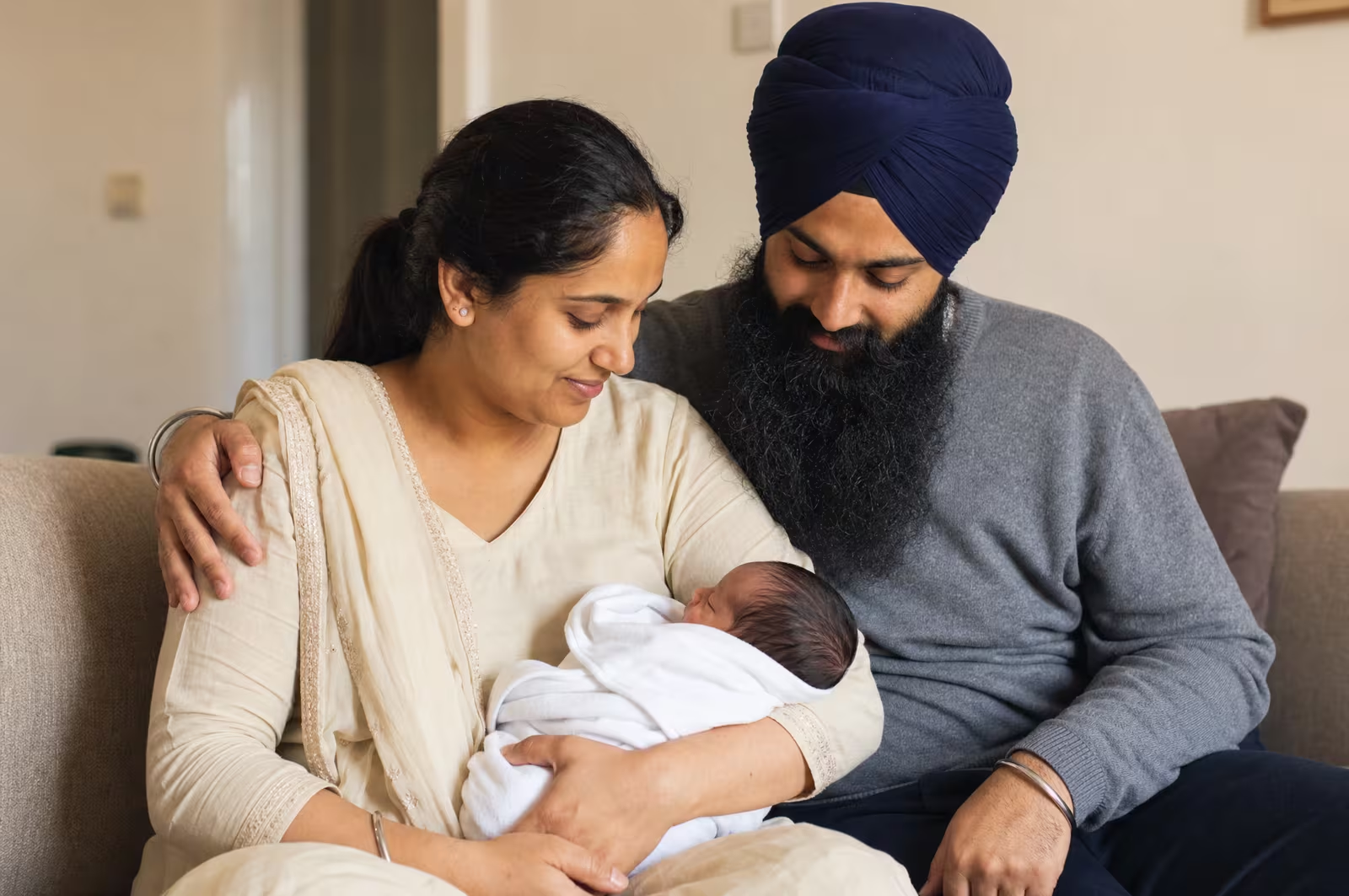
Singh (ਸਿੰਘ) means lion, and Kaur (ਕੌਰ) is often traced to kanwar, meaning prince or, in this reclaimed sense, princess or sovereign. Neither is a family surname. Guru Gobind Singh Ji gave these names in 1699, at Vaisakhi, when the Khalsa was founded, deliberately deleting the surname as a caste marker.
My full legal name has "Singh" in it, and for the first twenty-odd years of my life I never once asked why. It was just there, the way the sky is there. It took my own daughter asking me, "Dad, why do all the uncles have the same middle name?" for me to realise I didn't have a proper answer. I had the vibe of an answer. Not the thing itself.
So I went and learned it properly. And the story behind Punjabi names turned out to be one of the most radical things I've ever read about my own culture.
Singh and Kaur: not surnames at all
Here is the part most people get wrong, including me for most of my life. Singh (ਸਿੰਘ) and Kaur (ਕੌਰ) are not family surnames. They were never meant to function the way "Smith" or "Sharma" does.
Singh comes from the Sanskrit simha, meaning lion. Kaur is often traced to kanwar, meaning prince or, in this reclaimed sense, princess or sovereign. Notice the asymmetry got flipped on purpose: women were not given a "lioness" word that derived from the men's word. Kaur stands on its own. Royalty in her own right, not someone's daughter or someone's wife.
The names were given by Guru Gobind Singh Ji in 1699, at Vaisakhi, when the Khalsa was founded. (I wrote a bit about Vaisakhi itself in our festivals post if you want that context.) And the reason was deliberate and, for its time, subversive.
Why were Singh and Kaur given instead of surnames?
In the caste system, your surname was your caste. It told everyone, on first introduction, where you sat in a rigid hierarchy: who you could eat with, marry, touch. Your name was a label that followed you for life and decided your worth before you opened your mouth.
The Gurus rejected that completely. By giving every initiated Sikh man the name Singh and every woman the name Kaur, they did something simple and enormous: they deleted the caste marker. A king and a labourer, introduced by name alone, became indistinguishable. You could no longer rank a person by their name.
That is the idea I find beautiful. The names are not decoration. They are an argument, carried in every introduction, that human beings are equal. The pagg works in a similar way: for a Sikh it is an article of faith, not fashion, as I explain in Punjabi clothing words. Every time someone says Sat Sri Akal to a Kaur, they are (whether they know it or not) addressing a sovereign.
What do common Punjabi first names mean?
Because Singh and Kaur carry the shared message, the personal name is where Punjabi parents pour individual meaning. And Punjabi first names tend to mean something concrete, not just sound nice.
A few common ones, with their rough sense:
| Name | Gurmukhi | Meaning |
|---|---|---|
| Gurvinder | ਗੁਰਵਿੰਦਰ | one who knows the Guru / lord of the Guru's grace |
| Harpreet | ਹਰਪ੍ਰੀਤ | love of God (Har = God, preet = love) |
| Jaswinder | ਜਸਵਿੰਦਰ | lord of glory / one who praises |
| Manpreet | ਮਨਪ੍ਰੀਤ | love of the mind / heart's affection |
| Simran | ਸਿਮਰਨ | remembrance, meditation on God |
| Amrit | ਅੰਮ੍ਰਿਤ | nectar, immortality |
| Gurmeet | ਗੁਰਮੀਤ | friend of the Guru |
| Navdeep | ਨਵਦੀਪ | new lamp / ever-glowing light |
If you look closely you'll spot recurring building blocks. Gur (Guru), Har (God), preet (love), jas (praise), inder (a suffix tied to lordship/Indra). Once you know the pieces, you can half-read a Punjabi name's meaning the first time you meet it. That is one of those small unlocks that makes the language feel less like a wall and more like a set of doors.
There is also the lovely convention, drawn from the Guru Granth Sahib, of opening it at random and taking the first letter of the hymn on that page as the first letter of the baby's name. The name is, quite literally, given by the scripture. My own naming followed that practice. The G wasn't a coincidence my parents liked; it was the page that opened.
Why are Punjabi names spelled differently in English?
If you've noticed the same name spelled "Harpreet" and "Harprit," or "Kaur" and "Kor," that is the romanisation problem, not an error. Gurmukhi sounds don't map cleanly onto English letters, so everyone improvises. It's the same reason "Punjabi" and "Panjabi" both float around (I unpacked that whole thing in Punjabi or Panjabi). The script is stable; the Latin transcription is a guess that varies family to family. Guru Angad is credited with standardising Gurmukhi itself, one chapter in the long history of Punjabi.
This is exactly why I think reading the names in their own script matters. "Harpreet" tells you how to pronounce it for an English speaker. ਹਰਪ੍ਰੀਤ tells you what it is. Learning the 35 akhar is what lets you read your own relatives' names off a wedding card instead of squinting at someone's best-guess transliteration.
What I tell my kids now
When my daughter asked again, I gave her the real answer. I told her Kaur means she is no one's possession and no one's lesser. That a Guru, more than three hundred years ago, looked at a society built to rank people and decided that her name, specifically, would refuse to play along.
She's eight. She mostly wanted to know if it meant she was a princess. I said yes. Technically, scripturally, yes.
That conversation is a fair slice of why I ended up building a Punjabi app at all. A name you can't read the meaning of is a name slowly turning into a sound. I didn't want that for her, or for the cousins who can say Singh and Kaur but couldn't tell you they mean lion and sovereign. It is a small version of why Punjabi is fading in the diaspora. The meanings are still in there. Someone just has to hand them down.