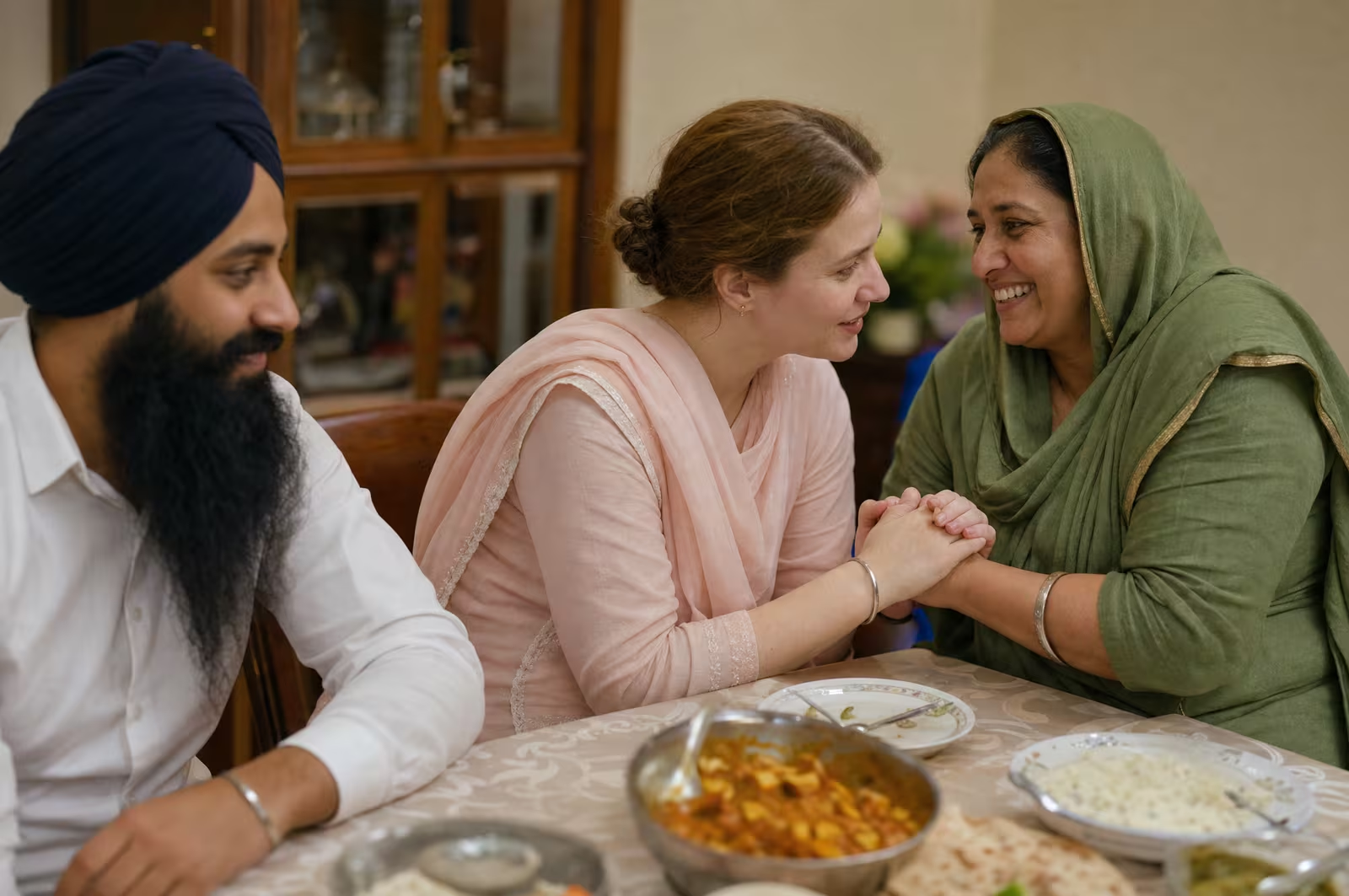
If you are marrying into a Punjabi family, start with the relationship words and a handful of warm phrases, not grammar. Learn what to call your in-laws, such as sass (mother-in-law) and sauhra (father-in-law), then greet elders with Sat Sri Akal, praise the food and offer to help. In-laws value the effort far more than fluency.
Punjabi families often talk fast. Picture your first evening at your partner's parents' kitchen table: daal steaming in front of you, a mama ji mid-story, a grandmother watching you with the patient look that grandmothers give when they are about to decide something about you. You understand maybe half of it. You can feel the other half slipping past, and with it the chance to actually be in the room rather than a polite guest in it.
If you are marrying into a Punjabi family, or you have just started getting serious with someone whose parents switch to Punjabi the second they relax, this post is for you. Not a grammar course. A short guide to the words that make in-laws decide you are one of theirs.
Why even a little goes a long way
Your in-laws are not grading your accent. They have likely watched English creep into their own children's mouths for decades. So when you, the partner from outside, try, it lands differently. It says: I see what matters to you, and I am not going to let it disappear in this marriage too. If you are still deciding whether Punjabi is worth learning for you, I weighed that up separately.
You do not need to be fluent. You need to be present. Five well-placed phrases at the right moment will do more than a memorised paragraph delivered nervously. If you already speak Urdu, some words will feel familiar, but Punjabi and Urdu are separate languages, not two accents of one.
Start with the names, not the nouns
The single best investment is learning the relationship words, because you will use them every single day and using the wrong one is instantly noticeable. Punjabi splits relatives far more finely than English does. Your mother-in-law is not just "her mum", she is your sass. Her father is your sauhra. Get these right early.
| Who | Punjabi | Say it |
|---|---|---|
| Mother-in-law | ਸੱਸ | sass |
| Father-in-law | ਸਹੁਰਾ | sauhra |
| Wife's brother | ਸਾਲਾ | saala |
| Wife's sister | ਸਾਲੀ | saali |
| Husband's younger brother | ਦਿਓਰ | diyor |
| Husband's sister | ਨਣਦ | nanad |
A fuller map lives in my post on Punjabi family words and relatives, and it is worth ten minutes before any big family event. Knowing whether to say chacha or mama (paternal vs maternal uncle) is the kind of detail that makes an aunt nudge her husband and whisper that you are switched on.
The phrases that actually win hearts
Forget the textbook openers. These are the ones that earn a smile across a table.
- "ਸਤਿ ਸ੍ਰੀ ਅਕਾਲ" (sat sri akal) with hands together, to elders, first thing. The greeting itself is a small bow.
- "ਖਾਣਾ ਬਹੁਤ ਸਵਾਦ ਹੈ" (khaana bahut swaad hai): the food is delicious. Say this to your sass and mean it. There is no faster route into a Punjabi mother's good books than appreciating her cooking out loud.
- "ਮੈਂ ਮਦਦ ਕਰਾਂ?" (main madad karaan?): can I help? Offering, in Punjabi, to clear plates or carry chai is worth more than any gift.
- "ਥੋੜਾ ਥੋੜਾ ਆਉਂਦੀ ਹੈ" (thoda thoda aundi hai): I understand a little. Humble, disarming, and it invites people to slow down for you rather than around you.
Notice none of these are complicated. They are small, warm, repeated. That is the texture of family life, and that is where you want to show up.
The wedding itself is a vocabulary all its own
If a wedding is on the horizon, you are about to meet a whole separate cloud of words: anand karaj, milni, laavan, doli. Knowing what is happening at each stage, and what to say when your father-in-law embraces your father at the milni, turns you from a spectator into a participant. I pulled the key terms together in Punjabi wedding words and phrases so you are not whispering "what is happening now?" through your own ceremony.
How I actually learned (and how I would tell you to)
I tried the obvious things first. A tutor was expensive and scheduled for a version of me with free weekday evenings I did not have. Apps did not even offer Punjabi. So I ended up doing it the slow way: native-quality audio in my ears on the commute, repeating phrases until the aspirated sounds (the breathy kh, gh, bh that English does not have) stopped tripping me up, a few minutes a day rather than a heroic Sunday session that never happened.
That daily-drip approach is exactly what I eventually built Panjabi Go around: native-quality audio with pronunciation feedback so your swaad does not come out as saad, the Gurmukhi script taught from the 35 akhar up so you can actually read your wedding invitation, and short lessons that fit between the rest of life. The pronunciation feedback matters here, because the difference between charming and accidentally-rude often hides in a single breathy consonant.
But whether you use an app, a patient partner, or both, the principle is the same. Pick five phrases (a greeting, how to say I love you, a thank-you for the food). Use them this week. Then five more. Your in-laws will meet you halfway long before you are fluent, because the effort is the message. I gathered the in-law words, meal phrases and wedding terms on one page: learning Panjabi for your partner's family.
The table goes quieter for the guest who only smiles. It opens up for the one who tries a few words. Be the one who tries.