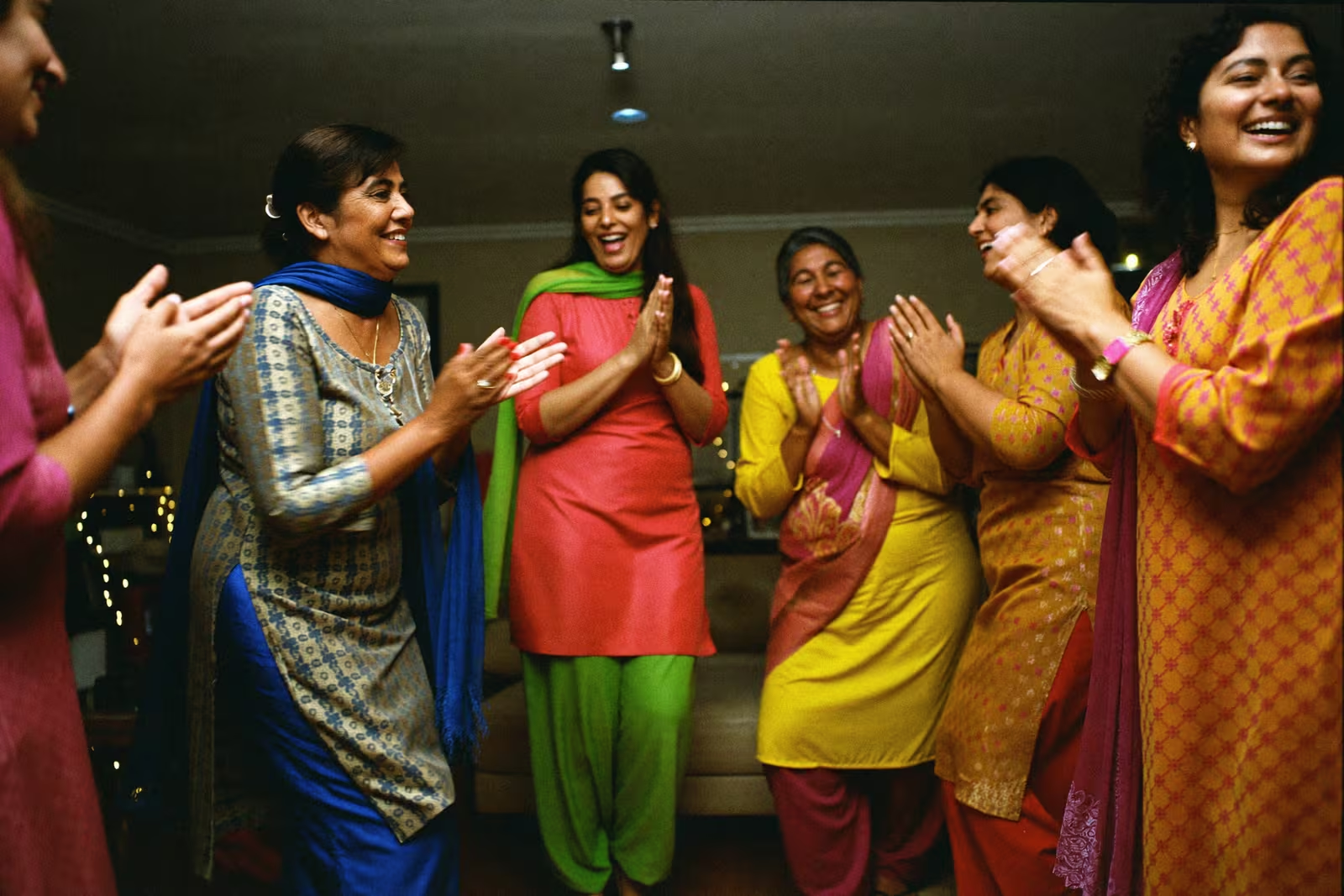
Boliyan (ਬੋਲੀਆਂ) are short, rhyming Punjabi folk couplets: one person calls out a line and the group answers with the refrain. They teach rhythm and sticky vocabulary such as mahiya (beloved), chann (moon) and sajna (dear one). They will not teach you to read Gurmukhi or conjugate verbs, so pair them with structured study.
As a small kid, long before I could string a proper Punjabi sentence together, I could shout "Balle balle!" with total confidence at a wedding. I knew the chorus of half a dozen boliyan without understanding a single word of the verses. My body knew the language before my brain did.
It took me years to realise that wasn't a party trick. It was a learning method, and a really good one, that I'd stumbled into by accident.
What are boliyan?
Boliyan (ਬੋਲੀਆਂ) are short Punjabi folk couplets, usually witty, often cheeky, sometimes biting. One person calls out a couplet, the group answers with the refrain, and someone dances in the centre. They're the engine of giddha (the women's dance, ਗਿੱਧਾ) and they thread through bhangra too.
What makes them perfect for learners is their shape. A boli is tiny. It rhymes. It has a punchline. And the refrain repeats endlessly, which means you absorb a chunk of real, grammatical, native Punjabi by sheer repetition without ever feeling like you're studying. That's the same spaced-repetition logic a good app leans on, except here the "app" is your auntie and a dholki.
Can you learn Punjabi from songs?
I'm the last person to tell you songs replace structured learning. They don't teach you to read Gurmukhi, and they won't drill the verb "to be" into shape. But for a few specific things, music outperforms any lesson:
Rhythm and stress. Punjabi has a music to it: where the beat falls, how a line rises and drops. You cannot drill that from a textbook. You catch it from a song, the way you caught the rhythm of nursery rhymes as a kid.
Sticky vocabulary. A word welded to a melody refuses to leave your head. I learned mahiya (ਮਾਹੀਆ, beloved), chann (ਚੰਨ, moon, used for a sweetheart), sajna (ਸੱਜਣਾ, dear one) entirely from songs, and they've never once slipped out of memory the way drilled words do.
Cultural texture. Boliyan are stuffed with references to village life, in-laws, harvests, longing, the pind. You don't just learn words; you learn what Punjabis talk about, tease about, ache about. That's context no vocabulary list gives you.
A few words you'll meet in the lyrics
If you start listening closely, the same warm cluster of words keeps surfacing. Worth knowing them:
| Punjabi | Gurmukhi | Meaning |
|---|---|---|
| mahiya | ਮਾਹੀਆ | beloved |
| chann | ਚੰਨ | moon (term of endearment) |
| dil | ਦਿਲ | heart |
| sajna | ਸੱਜਣਾ | dear one, sweetheart |
| pind | ਪਿੰਡ | village |
| gabru | ਗੱਭਰੂ | young man |
| mutiyaar | ਮੁਟਿਆਰ | young woman |
| jind | ਜਿੰਦ | life, soul |
Notice these aren't "textbook" words. They're the emotional vocabulary, the stuff people actually feel things about. Which is exactly why they stick.
How to use songs to learn, on purpose
The accidental version (absorbing choruses at weddings) works, but you can do it deliberately and get a lot more out of it. Here's the routine I'd give anyone:
- Pick one song you like. Not a "good for learning" song. A song you'd play anyway. Motivation does more work than method.
- Find the lyrics in Gurmukhi, not just romanised. Reading along while you listen is where the script finally sticks, because you're matching a sound you already know to a letter. (If the akhar are still new, that's its own foundation worth building first.)
- Learn the chorus cold. Just the refrain. Sing it badly. Singing forces your mouth into Punjabi shapes that silent reading never will.
- Translate three lines, not thirty. Pick the lines that grabbed you and look them up properly. A handful understood deeply beats a whole song understood vaguely.
- Repeat over days. Same song, a little more each time. This is the spaced part, and it's why songs you loved as a kid are still word-perfect decades later.
The folk tradition especially shines around festival season, when the boliyan come out in force. If you want the cultural calendar that surrounds them, I mapped out Vaisakhi and Lohri separately, and those are exactly the nights this music lives loudest. Vaisakhi also fills the Gurdwara, and I collected the Punjabi you will hear at the Gurdwara separately.
Where songs stop and study starts
I want to be clear about the ceiling, because I think over-promising does learners a disservice. Songs will give you rhythm, a stack of emotional vocabulary, real pronunciation models, and a deep love for the sound of your language. They will not teach you to read fluently, conjugate reliably, or hold a conversation about train timetables. For that you need structure, and I've laid out the fuller picture of how to actually learn elsewhere.
Think of it this way: songs are the fire that keeps you wanting to learn. Structure is the wood that keeps it burning. You need both, but the fire has to come first, and nothing lights it like hearing a boli land at full volume in a room full of people who love it.
So here's my actual advice, the least homework-shaped advice I'll ever give. Go find a Punjabi song you love. Read the words in Gurmukhi while it plays. Sing the chorus until your family laughs at you. That's a real lesson, and it doesn't feel like one. Which, when you're trying to come back to a language you half-lost, might be the only kind of lesson that lasts.