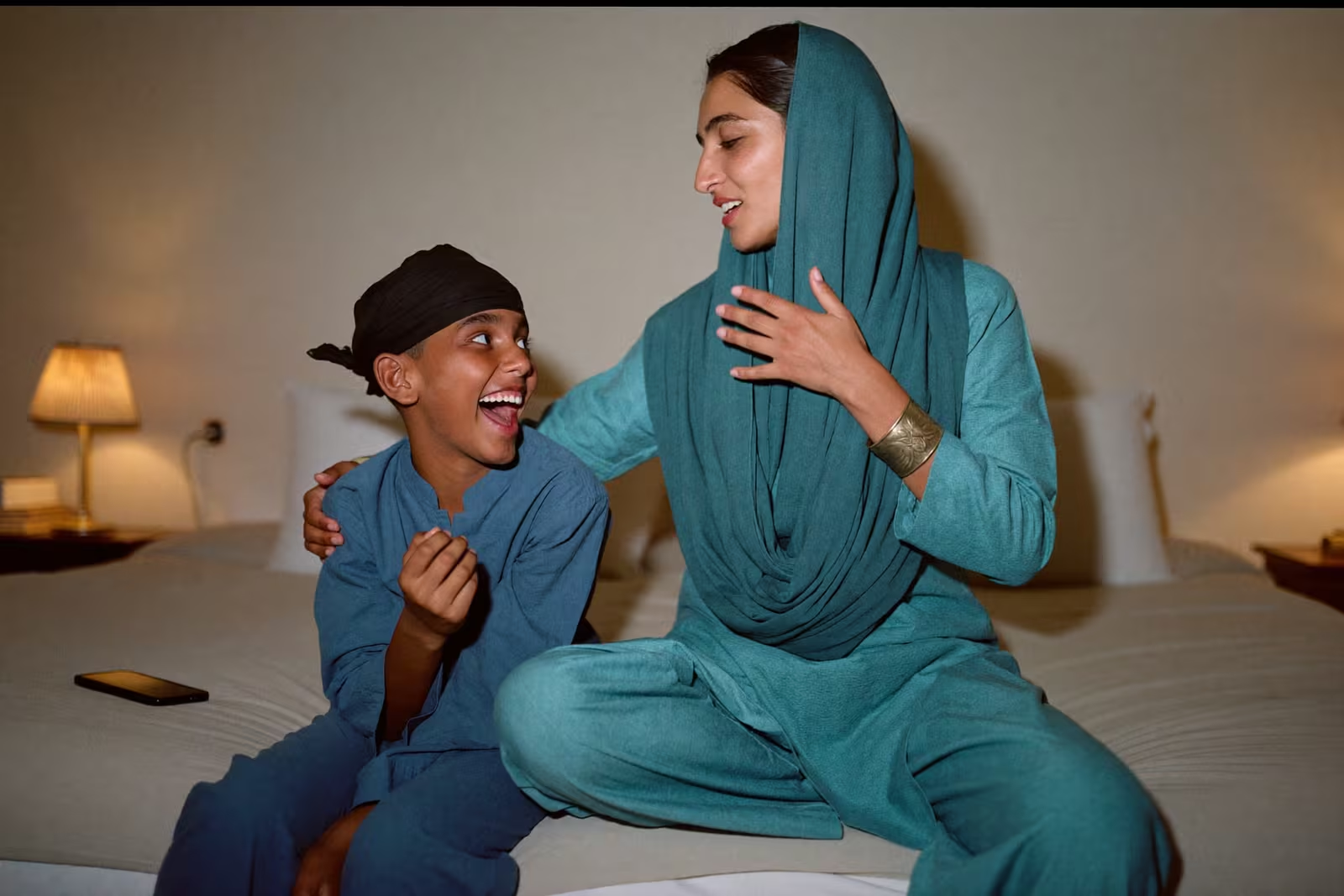
To raise a Punjabi-speaking child in an English-speaking country, make Punjabi deliberate rather than leaving it to chance. Speak Punjabi at home as much as you can, with both parents using it if you both can, or one parent, one language (OPOL) if only one of you can, keep replying in Punjabi when they answer in English, and give them reasons to use it: grandparents, food, the Gurdwara and festivals.
I did not lose Punjabi in a single moment. It leaked. School was English, friends were English, television was English, and Punjabi shrank to the conversations at home, because it was the only language my parents spoke. By the time I was an adult I could still speak it, but the confidence had drained away, especially with relatives from Punjab. That is a strange and specific kind of grief: the words are still in you, but they no longer come when you need them.
If you are raising children far from Punjab and you do not want them to inherit that gap, this is the post I wish someone had handed my parents. It is the deeper companion to my more practical teach kids Punjabi at home, and it is about the long game: how a heritage language actually survives in a child who is swimming in English all day.
First, understand what you are fighting
You are not fighting your child's ability. Children absorb languages effortlessly when they get enough input. You are fighting displacement. English is everywhere, Punjabi is in your house and maybe the Gurdwara, and a child is ruthlessly efficient: they learn what they need to function, and they drop what they can survive without.
I wrote about how this plays out across the diaspora in why Punjabi is disappearing in the diaspora. The short version: each generation passes on a little less, until one generation passes on almost none, usually without ever deciding to. Knowing this is the point. Heritage language transmission does not fail loudly. It fails by default. So you have to make it deliberate.
What is OPOL (one parent, one language)?
The best-known framework for bilingual households is OPOL, one parent one language. One parent speaks consistently in Punjabi, the other in English (or the community language). The child learns to associate each language with a person, and crucially, gets a steady, non-negotiable stream of Punjabi from one trusted source.
It helps, but the research says more Punjabi is better. In a study of 1,899 bilingual families, the linguist Annick De Houwer found that about 74% of OPOL children actively spoke the home language. When both parents spoke only the home language, it was 97%. Children learn each language roughly in proportion to how much of it they hear.
So if you both speak Punjabi, use it with each other and with the child, and let school supply the English. If only one of you does, OPOL is the plan, and that parent has to be the one who simply does not switch, even when it would be easier, even when the child answers back in English.
A few notes from watching families do this:
- The child will answer in English. Often. This is normal and not failure. Keep replying in Punjabi. Comprehension comes before production, sometimes by years. They are banking it.
- Pick the parent with more Punjabi, even if it is not the "main" caregiver. Quality of input matters.
- If only one of you speaks Punjabi, OPOL still works. That parent becomes the Punjabi world, full stop.
Can you teach your child Punjabi if you are not fluent?
Here is the trap I fell into thinking about my own future kids: "I can't teach what I half-know." Plenty of diaspora parents understand Punjabi but do not feel confident speaking it. OPOL feels impossible if you are not sure of your own grammar.
The answer is not to give up the language. It is to learn alongside your child, out loud, unembarrassed. Children do not need a perfect model. They need a present one. When you look up a word together, when you get the gender of a noun wrong and correct it, you are teaching something more valuable than vocabulary: that this language is worth the effort and that mistakes are part of it. If your own speaking is rusty, I wrote up how I practised speaking Punjabi alone.
This is part of why I built Panjabi Go. I needed to rebuild my own Punjabi to a place where I could pass it on, and the pieces that mattered were the native-quality audio with pronunciation feedback (so I was not teaching a child my own mispronunciations) and the Gurmukhi script taught properly from the 35 akhar, so reading would be on the table for them, not just kitchen-table speech. Short daily lessons meant I could do it in the cracks of a working day rather than pretending I had hours.
Build a Punjabi world, not a Punjabi class
Lessons alone will not save a heritage language. Children learn a language they have a reason to use. Your job is to manufacture reasons.
| Domain | What it gives the child |
|---|---|
| Food and the kitchen | Daily, repeated, sensory vocabulary they cannot avoid |
| Grandparents and video calls | A person they must use Punjabi with, the strongest motivator there is |
| Gurdwara and festivals | Belonging, rhythm, words tied to feeling |
| Songs, rhymes, cartoons in Punjabi | Effortless input disguised as play |
The Gurdwara and the festival calendar do quiet heavy lifting here. Vaisakhi, Lohri, the rhythm of langar: these attach the language to joy and identity rather than homework. A child who associates Punjabi with their nani's laugh and the smell of jalebi will hold onto it far longer than one who only meets it in worksheets.
Protect the grandparents while you have them
The most important Punjabi teacher in your child's life is probably the oldest person in your family, and that window does not stay open. Grandparents speak the richest, most natural Punjabi, full of idiom and warmth, and they have endless patience for a small child. Get the children in front of them, in person or on a screen, as often as you possibly can. Make the calls a habit, not an occasion. When my own nani was still here, every conversation I could not fully have with her is one I cannot get back. Do not let your kids inherit that regret.
The long, gentle truth
You will have weeks where it slides, where English wins, where you are too tired to keep switching. That is fine. This is a marathon measured in years, not a streak you can break. The children who keep Punjabi are rarely the ones whose parents ran a perfect programme. They are the ones whose parents simply refused to let the language leave the house, day after ordinary day.
Your child does not need a curriculum. They need a parent who keeps speaking, a grandparent on the line, and a home where Punjabi is just normal. Make it normal, and you have already done the hardest part.