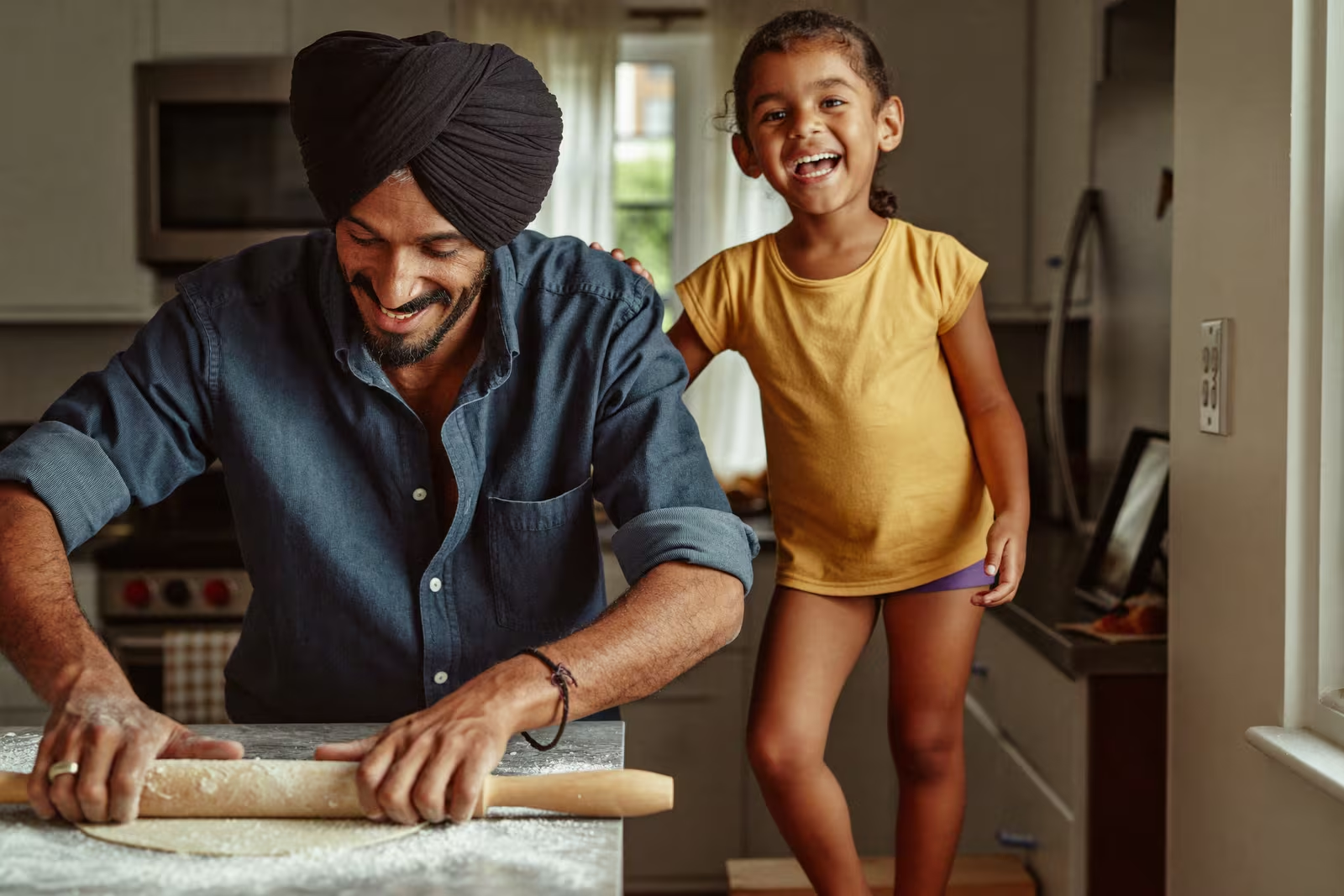
The most effective way to teach your kids Panjabi at home is to make it the language of one protected part of daily life, such as mealtimes, bedtime or calls with grandparents. Lead with songs and sound before the alphabet, add Gurmukhi once they speak comfortably, and keep practice small, daily and joyful.
I'll tell you why this one is hard for me to write calmly. I grew up speaking Panjabi, because it was the only language my parents spoke. Then school and friends made English my default, and bit by bit I lost my confidence in it. When I had kids of my own, the thought that they might grow up unable to speak it at all terrified me. That fear is the reason Panjabi Go exists.
So if you grew up in the UK, Canada, the US, or Australia, you can understand Panjabi, and your own kids reply to nani in English, I want to say this plainly: you are not failing. You're up against one of the strongest currents in any diaspora family. The dominant language wins by default. Schools, friends, screens, and shops all run in English. Panjabi survives only where someone actively makes room for it.
Here's the encouraging part, and it's the reason I built Panjabi Go in the first place. That "someone" doesn't have to be a perfect speaker or a formal teacher. They have to be consistent, warm, and a little bit stubborn. I want you to succeed where my own generation drifted. Here's how to do it at home.
Is it worth teaching your kids Panjabi?
Heritage language isn't just communication, it's the bridge to grandparents, to Gurbani, to the jokes that don't translate, to a child's own sense of who they are. Teenagers in immigrant families who speak the family language well tend to have a stronger sense of ethnic identity, and some studies find cognitive benefits in bilingual children, though that second finding is still debated. But the research is the smaller half of it for me. You're not just teaching words. You're handing your child a door back to where they come from, and keeping it open while the people on the other side are still here to walk through it.
The one rule that matters most: make it the language of something
Children don't learn a language because it's good for them. I certainly didn't. They learn it because they need it for something they care about. Your job is to make Panjabi the required language of a real part of daily life, not a subject.
Pick a domain and protect it:
- Mealtimes in Panjabi. Food vocabulary is concrete and repeats daily.
- Bedtime stories and prayers in Panjabi.
- One parent, one language, if it fits your family, one parent speaks only Panjabi to the child.
- Calls with grandparents as a Panjabi-only zone.
Consistency in one domain beats scattered words everywhere. The child learns: in this space, Panjabi is how things work. This is exactly the wall I never had. English was allowed to leak into everything, so it took everything.
Start with sound and song, not the alphabet
For young children, lead with the ear. Punjabi nursery rhymes, boliyan, children's songs, and simple call-and-response games build the sounds and rhythm long before any reading. The retroflex and aspirated sounds that adults like me struggled to retrain (the ਟ vs ਤ, the ਖ vs ਕ) are absorbed effortlessly by a young child who just hears them often enough. Give them that ear early and you're saving them the relearning I had to do at thirty.
Save formal Gurmukhi reading for when they're a little older and already comfortable speaking, the same order an adult should follow in the beginner's guide. When that time comes, the 35 Akhar is your reference.
Practical strategies by age
Toddlers (1 to 4): Label the world. Point and name, paani (water), roti (bread), dudh (milk). Sing. Keep it playful and pressure-free.
Young kids (5 to 8): Add simple back-and-forth. Ask questions in Panjabi that need a Panjabi answer. Introduce the alphabet through songs. Tie it to identity, "this is our language."
Tweens and teens (9+): Respect their world. Panjabi music, films, social media creators, and texting nana-nani keep it relevant. Let them see Panjabi as cool and current, not just ancestral. This is the age I drifted hardest, so I have a soft spot for the parents fighting to keep a teenager engaged. It's worth the effort.
What if your child refuses to speak Panjabi?
At some point your child will answer your Panjabi in English, or say "I don't want to." This is normal. It's also the exact moment my own parents, with the best intentions, let it slide. A few things that help:
- Don't punish the language. If Panjabi becomes a chore or a fight, you lose.
- Repeat their English back in Panjabi, gently, instead of demanding they switch. You model; you don't drill.
- Find other Panjabi-speaking kids. Peer use is rocket fuel, Sunday Gurdwara schools and community classes exist for exactly this.
- Celebrate output, not perfection. A mangled sentence that tried is a win.
A realistic home routine
You don't need an hour. You need anchors:
| Time | Anchor |
|---|---|
| Breakfast | Name foods, ask "ki khaana hai?" |
| After school | Share one word from your own 10 min lesson |
| Dinner | One Panjabi-only conversation topic |
| Bedtime | A story or song in Panjabi |
Small, daily, repeated. That's the whole secret, the same daily-habit principle that works for adult learners, just wrapped in family life.
Where an app fits
I'll be straight about what an app can and can't do, because I built one and I still won't oversell it. An app can't replace you, and Panjabi Go isn't a kids' app. It's for ages 13 and up, and it's built for you, the parent. It gives you short daily lessons with native-quality audio and pronunciation feedback, including tones, plus Gurmukhi from scratch and spaced repetition so it sticks. That audio matters more than people realise. Children copy the sounds they hear, so the clearer your Panjabi is, the clearer theirs will be. When you relearn it yourself, you also show your kids the most powerful lesson of all: this language is worth our time.
If you want one plan for the whole household, the Family Pack gives four people a Fluent seat each, so you, your partner, a teenager aged 13 or over and a grandparent can each keep their own progress. I wrote more about this on a page for parents: learn it so you can pass it on.
Keep reading:
- How to Learn Punjabi: A Complete Beginner's Guide: for you, so you can model it
- The Gurmukhi Alphabet: All 35 Akhar: when they're ready to read
- 5 Everyday Panjabi Phrases to Learn First: start tonight at dinner